




Marketing plan to sell your home: what sellers really need to understand
In short: there is no “magic marketing plan” that will sell your home faster and for more money. The real plan rests on two pillars: price (proper positioning) and presentation (photos and showcasing). Since the vast majority of buyers search on Centris, Realtor.ca, or through their broker’s alerts, price determines whether your property is seen, and presentation determines whether it is visited. David Tardif, a real estate broker in Quebec and founder of Endurance Groupe Immobilier par Tardif, explains in simple terms how to position a property properly.
Quick response
The best marketing plan to sell your home is to list it at the right price, in the right place, in its best light. Since the vast majority of buyers find their future property on recognized platforms (Centris, Realtor.ca, DuProprio) or through their broker’s alerts, two elements decide almost everything: price, which determines whether your home appears in qualified buyers’ searches, and visual presentation, which triggers the visit. Open houses, signs, and social media ads are useful complements, but none replaces proper positioning and professional photos. For a reliable starting point, request a free value opinion.
Simple to understand
Selling a home is a bit like putting a product on a store shelf. The list price is not always the price buyers are truly willing to pay. If your product sits on the shelf too long, it is almost never because it is “bad”: it is because the price, the presentation, or the timing is not aligned with what the market wants.
Imagine two identical boxes, side by side. One is well lit, clean, and priced fairly. The other is in the shadows and costs 10% more. Which one sells? A home is the same: it is not advertising efforts that sell it, it is the balance between a fair price and a strong presentation.

Does the magic marketing plan really exist?
“What is your marketing plan to sell my home?” It is one of the first questions sellers ask, and that is normal: you do not sell a home every day. So, this magic plan that some brokers describe as a “unique strategy”… does it really exist?
Here is the honest answer: the marketing plan that sells your home is, first and foremost, the price. The market price — how your property is positioned relative to others — is the number-one factor in a successful sale.
The market price is the price at which your property is listed at the start. It is not a promise of sale, but a strategic positioning to expose your home to the largest number of qualified buyers.
Open houses, social media, and signs can help. But to understand what really matters, you have to go to the source: how do buyers actually search, in practical terms?
How buyers really search today
Buyers are the raw material of a successful transaction. Without a buyer, there is no sale. Let’s look at their method.
Broker collaboration is the norm. In Quebec, a large share of buyers are represented by their own broker, often from a different agency than the seller’s. In fact, the OACIQ reminds us that the seller’s broker must expose the property to the largest number of buyers possible to obtain the best price. Other buyers handle things on their own or contact the broker listed on the sign directly.
Since June 10, 2022, the Real Estate Brokerage Act has prohibited dual representation in residential transactions: the same broker can no longer represent both the seller and the buyer in the same transaction. If you contact a seller’s broker directly, they must remain neutral toward you. To be truly advised and protected, a buyer must sign their own buyer brokerage contract — that is the essence of buyer representation.
The vast majority of buyers find their home on platforms. Today, most buyers discover their future property through recognized platforms — Centris, Realtor.ca, DuProprio — or through alerts set up by their broker. A minority uses other channels: social media, private sales, word of mouth.
The conclusion is simple: if the vast majority of sales go through these platforms, then what makes the difference are the two factors that act like a magnet or a repellent: price and presentation.
Price: the first search filter
On Centris or Realtor.ca, no one searches at random. Buyers set up alerts with precise criteria: area, property type, number of bedrooms and, above all, a maximum price.
An alert is an automated search. As soon as a property matching the buyer’s criteria comes on the market, they receive a notification. If they set their budget at $400,000, they will not see properties listed at $405,000.
The psychological barrier of filters. A home worth $395,000 but listed at $405,000 “to leave some room” disappears instantly from the alerts of all buyers who capped their search at $400,000. The seller excludes themselves from their best pool of buyers.
Immediate comparison. In three clicks, a buyer compares your price with similar properties sold recently in the same area. Price hides or reveals the true value.
If three similar condos sold between $520,000 and $540,000 in your building, but you list yours at $599,000, the market will perceive it as overpriced, even if it is in perfect condition.
A price that is too high drives away the best buyers in the very first weeks, precisely when a property attracts the most attention.
Presentation: what triggers the visit
Price makes your home appear. But it is visual presentation that pushes the buyer to click and request a visit.
The 3-second rule. The cover photo decides whether the buyer scrolls through your listing or moves on to the next one. Three seconds, no more.
The “wow” effect. Dark photos or cluttered rooms kill interest instantly. Conversely, clean staging, professional photos, and a video tour create a sense of urgency and competition.
Home staging is the art of presenting a property in its best light: declutter, depersonalize, highlight light and space, so the buyer can picture themselves living there.
In summary: a poorly presented property, even at the right price, does not attract attention; an overpriced property, even with great photos, will not be seen by qualified buyers. Success depends entirely on the balance of these two pillars. That is exactly the foundation of Endurance’s marketing plan: professional HDR photos, a Matterport 3D tour, and maximum exposure.
How to know if your price is too high
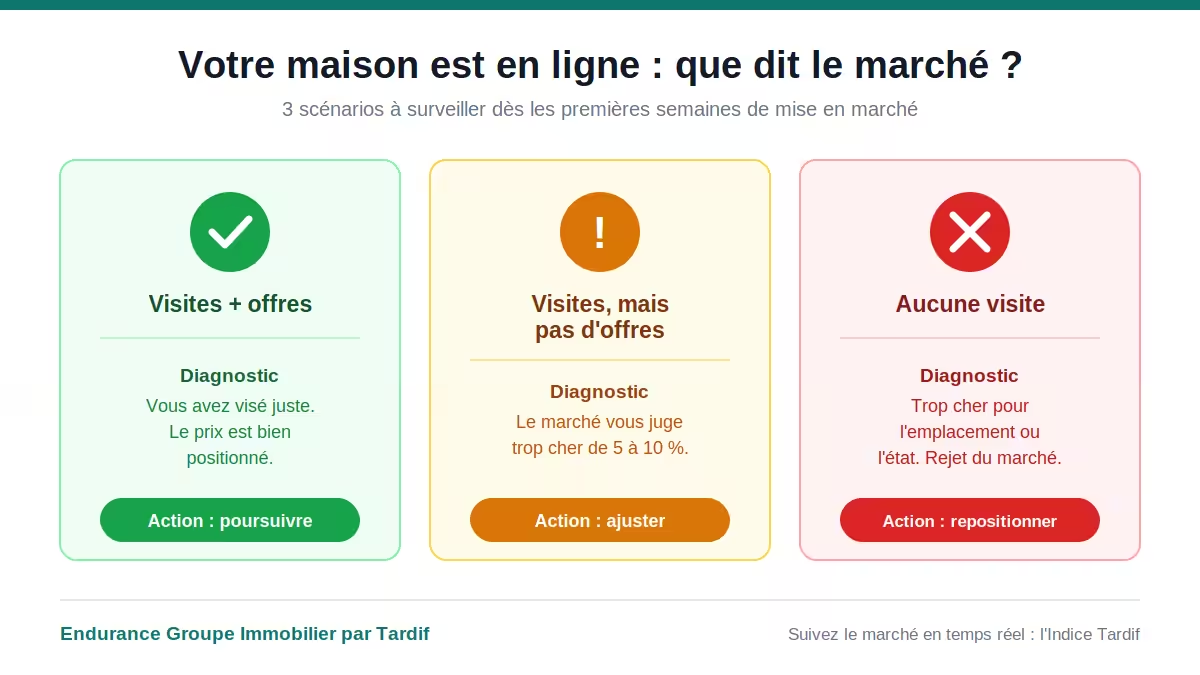
Once it is online, the market responds quickly. Within your area’s median selling time, three scenarios are possible.
The median selling time is the typical time a comparable property takes to sell in your area. It is your benchmark for judging whether things are moving normally.
- Quick visits, interest, offers. You got it right. The market validates your positioning.
- Visits, but no offers. The market considers you overpriced, generally by 5% to 10%. An adjustment will be necessary.
- No visits. The market rejected you upfront: too expensive relative to the location or condition, sometimes both.
Buyers have access to information. They know how long you have been for sale, whether your listing has expired or whether you have withdrawn your home from the market.
An expired listing is a property put up for sale that did not sell before the end of the brokerage contract. A withdrawn property was taken off the market by the seller before the end of the contract. In both cases, it is a signal buyers notice.
Most buyers then wonder: “Is this a good purchase? And the day I want to resell, will it resell well?” If the home lingers, the perceived answer is not reassuring. Tracking market signals in real time is exactly the role of the Tardif Index.
Fixing a bad start: Bryanna’s example
Can you recover from a bad launch? Yes, but you have to do it properly.
A few years ago, a client — let’s call her Bryanna — wanted to sell her condo. The recommended positioning was $500,000; she preferred to list it at $550,000. The warning was clear: at that price, the condo would be “overlisted” and would push away a solid pool of buyers. Her decision was respected, with a review date planned in advance. As expected: two weeks, no visits, no offers.
We went back to the initial strategy. The property was repositioned at $499,000… and sold three days later for $545,000.
“That makes no sense!” On the contrary. Here is the mechanism, and it is essential. You do not do a simple price reduction: it leaves a visible history and sends the signal “no one wanted it.” The right method:
- Cancel the brokerage contract with the broker.
- Bring the property back as a new listing, with refreshed text and photos.
- Reposition the price meaningfully, enough to reach another layer of buyers.
When you cancel and restart cleanly, the price history no longer appears, and buyers and brokers receive a new alert for an updated property. That is what generated competition.
This strategy must be executed properly and in compliance. It is not a trick to improvise: it is a strategic decision that must be planned with an experienced broker.
One important truth to finish: whether you are a seller, buyer, broker, or appraiser, no one can predict a home’s sale price with exact accuracy. You can establish a positioning, then let the market speak freely. That is the real marketing plan: no magic formula, but strategy, rigor, and an honest reading of the market.
What this means for you
For sellers
- Price is your real marketing plan. A fair price makes you visible; a price that is too high makes you invisible to the best buyers.
- Presentation determines the visit. Invest in professional photos and careful staging.
- Watch the signals in the first few weeks and correct a bad start intelligently.
Endurance’s approach confirms it in the field: on average 99% of the asking price achieved and 29 days average time on market. The starting point is the value opinion.
For buyers
- Set up your alerts with a realistic budget: good, well-priced properties move fast.
- A property that comes back “as new” is worth a look: it may have been repositioned.
- Be represented by your own broker and be pre-qualified. See buyer representation.
For investors
- Price positioning also applies to plexes. An overpriced building stays invisible to those filtering by yield. See available properties.
- Look at real income and comparables, not the list price.
- Area liquidity matters. Track market pressure via the Tardif Index before buying.
David Tardif’s analysis
According to David Tardif, a real estate broker in Quebec and founder of Endurance Groupe Immobilier par Tardif, the biggest mistake a seller can make is not choosing the wrong advertising: it is believing that a “magic marketing plan” can compensate for a poorly positioned price.
“The market is not read only through list prices. You have to look at selling times, expired listings, financing conditions, product quality, and sellers’ real motivation. In the end, the sale rests on two honest levers: position the price correctly and present the property in its best light. The rest is amplification.”
It is this strategic reading of the data — formalized each month in the Tardif Index — that guides every value opinion at Endurance.
Frequently Asked Questions
What is the best marketing plan to sell your home?
The best marketing plan rests on two pillars: price and presentation. A well-positioned price makes your property appear in qualified buyers’ searches on Centris and Realtor.ca, and a polished presentation triggers visits. The other tools (open houses, social media) are complements, not the decisive factor.
How do I know if my home is overpriced?
Watch the market in the first few weeks. Visits without offers generally mean a price 5% to 10% too high. No visits means a clearly overpriced price. Visits followed by offers indicate a fair price.
Why does an overpriced price scare buyers away?
Buyers search in budget brackets. A home listed at $405,000 disappears from the alerts of those who capped their search at $400,000. The seller excludes themselves from their best pool of buyers.
Can you recover a home that is not selling?
Yes, but not with a simple price reduction. You cancel the brokerage contract, bring the property back as a new listing with refreshed text and photos, then reposition the price significantly to reach another pool of buyers. This strategy must be executed with an experienced broker.
What is an expired listing in real estate?
An expired listing is a property put up for sale that did not sell before the end of the brokerage contract. Buyers notice it, which can hurt the perceived value of a property that comes back on the market.
Can a broker represent the buyer and the seller at the same time in Quebec?
No. Since June 10, 2022, dual representation has been prohibited in residential transactions in Quebec. The same broker cannot represent both parties in the same transaction. To be advised and protected, a buyer must sign their own buyer brokerage contract.
Can a broker predict the exact sale price of my home?
No. No one can predict a property’s sale price with exact accuracy. You can establish hypotheses and strategic positioning, then let the market speak freely. That is why price and presentation are the real key.
How does David Tardif analyze the real estate market?
David Tardif analyzes the market beyond list prices: selling times, expired listings, financing conditions, property quality, and sellers’ motivation. To track the Greater Montreal market in real time, he publishes the Tardif Index.
Need a clear analysis of your real estate situation?
David Tardif, a real estate broker in Quebec, and Endurance Groupe Immobilier par Tardif support owners, buyers, and investors who want to make better decisions. Whether you are thinking of selling, buying, or simply understanding the true value of your property, the goal is simple: to give you a clear reading of the market before you decide.
And to follow the Greater Montreal market week after week, consult the Tardif Index.